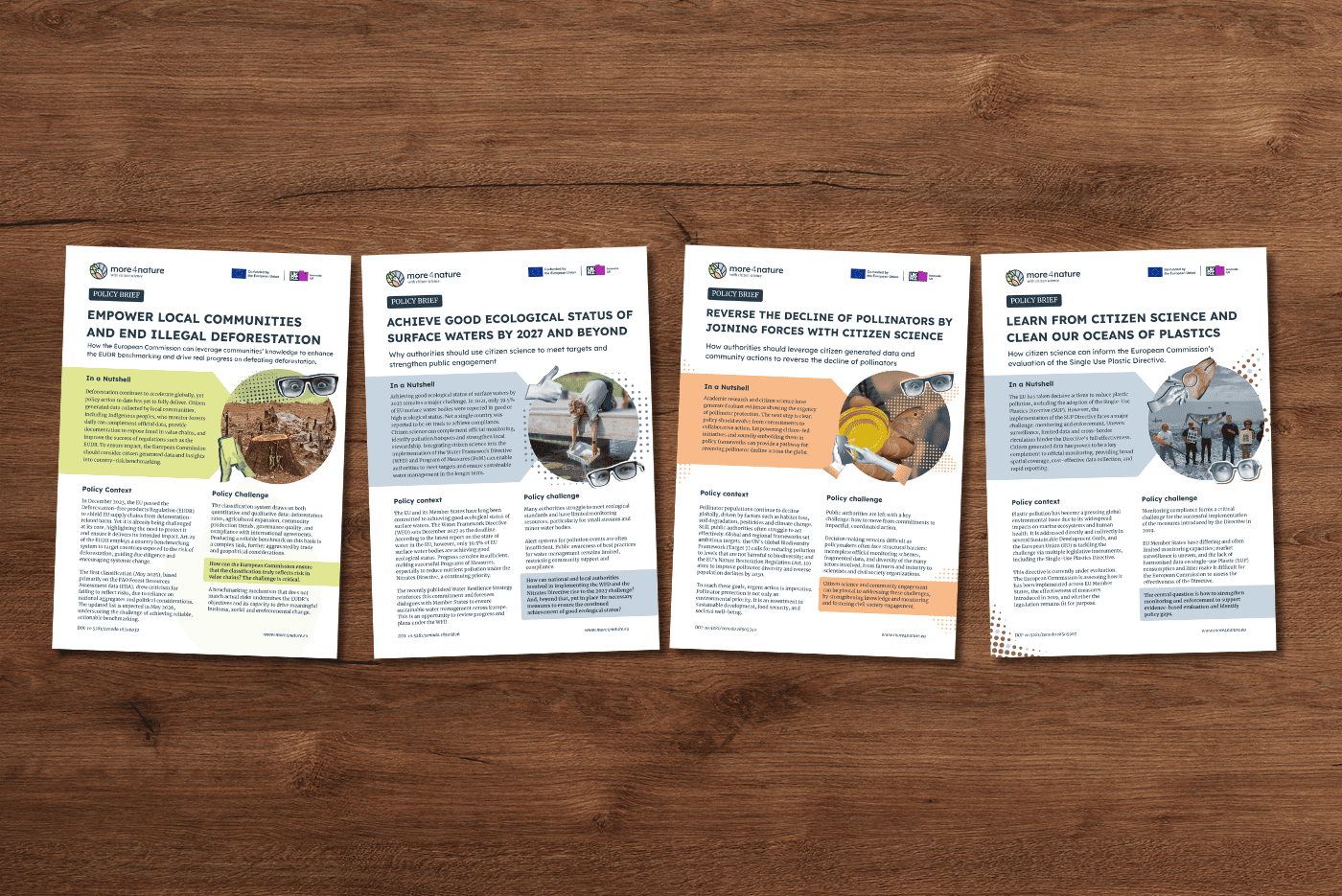
Four new policy briefs present more4nature’s specific recommendations addressing issues currently high on the European environmental policy agenda: pollinator protection, coastal plastic pollution, ecological status of surface water bodies, and deforestation linked to trade.
Across environmental legislation, a persistent gap remains between regulatory ambition and practical implementation at all levels, global, European, national. While environmental objectives become increasingly complex and ambitious, the authorities responsible for delivering them are operating with declining human resources and limited monitoring capacity. This growing imbalance makes it increasingly difficult to obtain timely data, access local insights, detect emerging pressures, respond swiftly, and verify compliance by duty holders. In this context, collaboration with citizens and communities is not simply desirable, it is becoming essential. By supporting citizen science and citizen action, environmental compliance assurance can be strengthened with new sources of knowledge, expanded monitoring reach, and more responsive, locally grounded oversight.
The Horizon Europe-funded more4nature project has produced four policy briefs containing recommendations aimed primarily at European legislative bodies and national environmental agencies with responsibilities in pollinator conservation, coastal pollution from plastics, surface waters health, and deforestation and its associated trade. The aim is to provide specific insights based on project activities on how specific changes in legislation could pave the way for institutionalising the collaboration between citizens and authorities in environmental compliance assurance and, consequently, strengthen environmental protection in these areas.
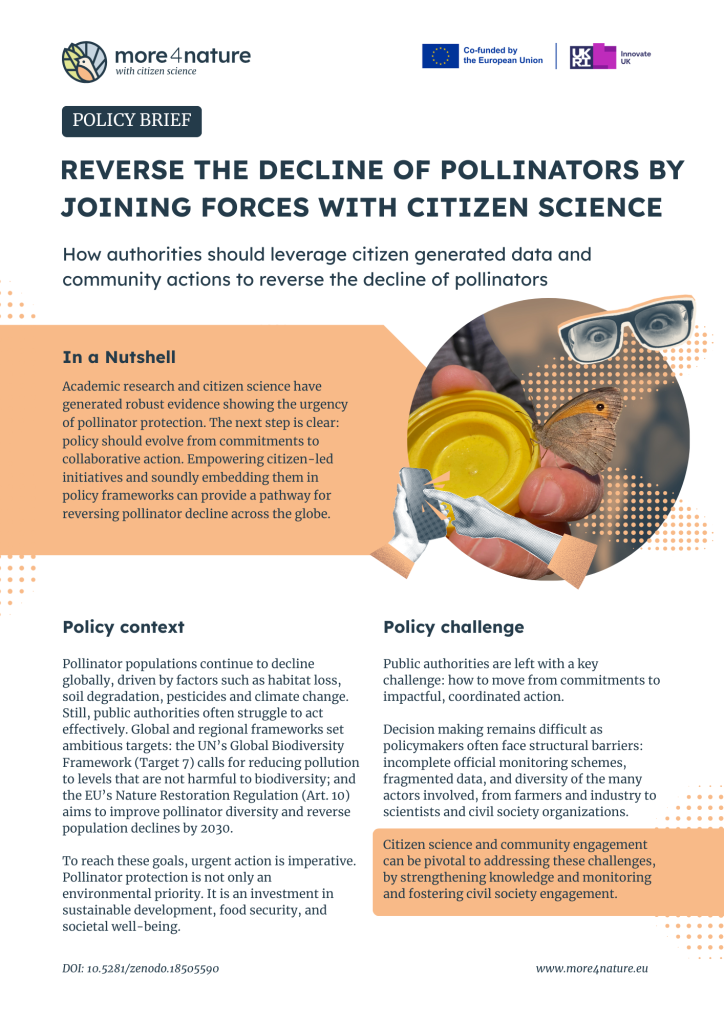
Reverse the decline of pollinators by joining forces with citizen science
Academic research and citizen science have generated robust evidence showing the urgency of pollinator protection. This policy brief highlights that the next step is clear: policy should evolve from commitments to collaborative action. Empowering citizen-led initiatives and soundly embedding them in policy frameworks can provide a pathway for reversing pollinators decline across the globe.
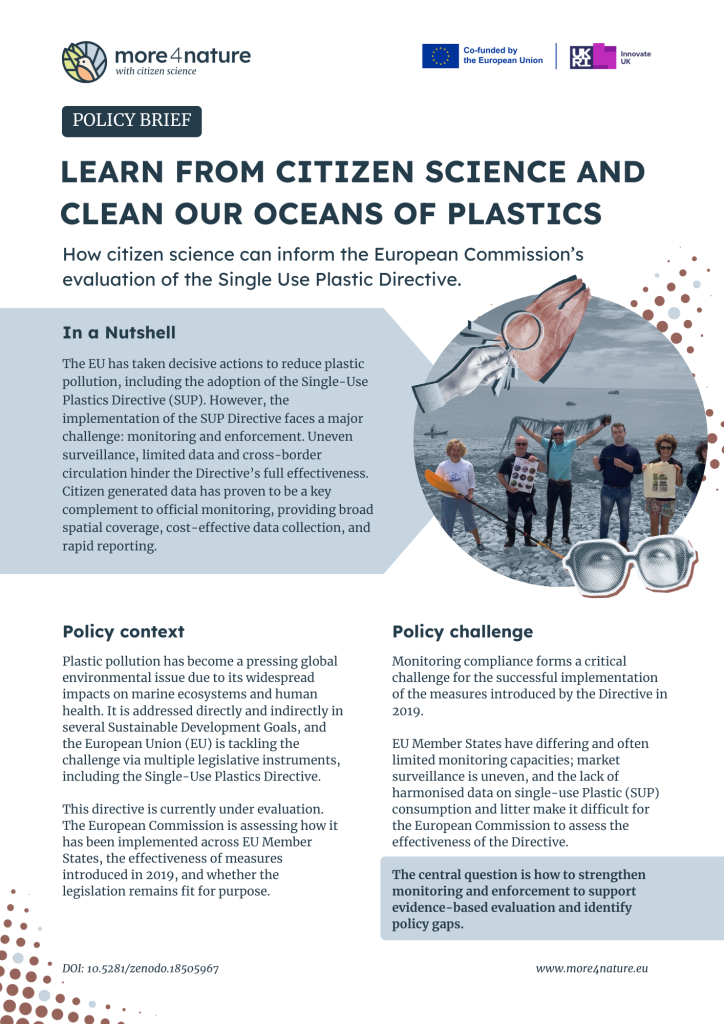
Learn from citizen science and clean our oceans of plastics
The EU has taken decisive actions to reduce plastic pollution, including the adoption of the Single-Use Plastics Directive (SUP). However, the implementation of the SUP Directive faces a major challenge: monitoring and enforcement. Uneven surveillance, limited data and cross-border circulation hinder the Directive’s full effectiveness. This policy brief shows how citizen generated data has proven to be a key complement to official monitoring, providing broad spatial coverage, cost-effective data collection, and rapid reporting.
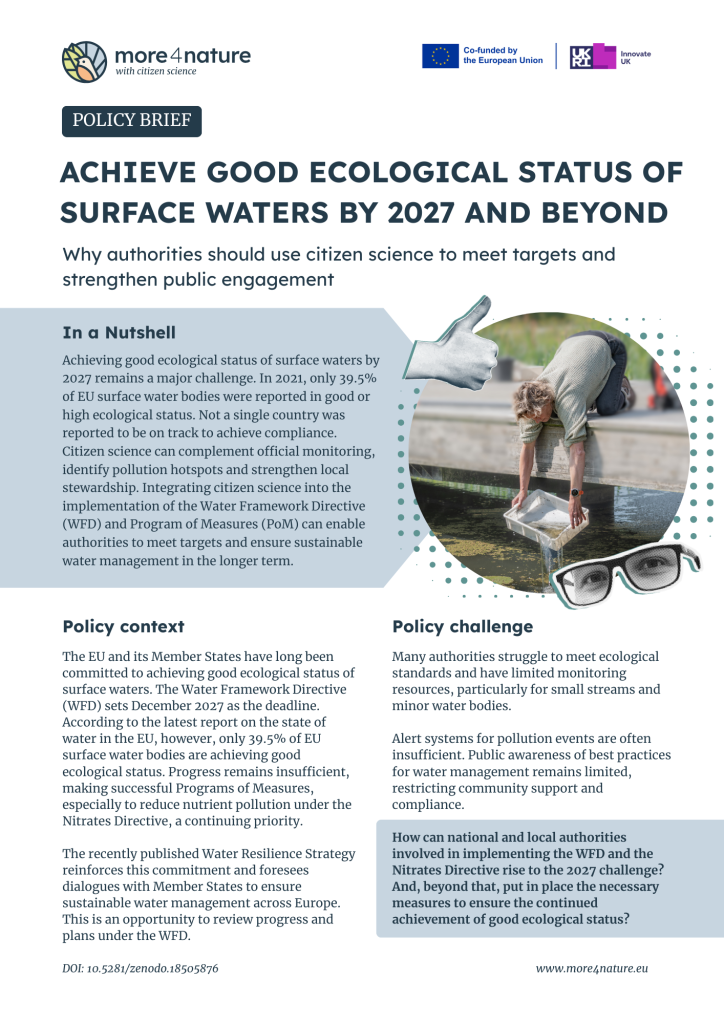
Achieve good ecological status of surface waters by 2027 and beyond
Achieving good ecological status of surface waters by 2027 remains a major challenge. In 2021, only 39.5% of EU surface water bodies were in good or high ecological status. Not a single country reported to be on track to achieve compliance.
Citizen science can complement official monitoring, identify pollution hotspots and strengthen local stewardship. This policy brief suggests that integrating citizen science into the implementation of the Water Framework Directive (WFD) and Program of Measures (PoM) can enable authorities to meet targets and ensure sustainable water management in the longer term.
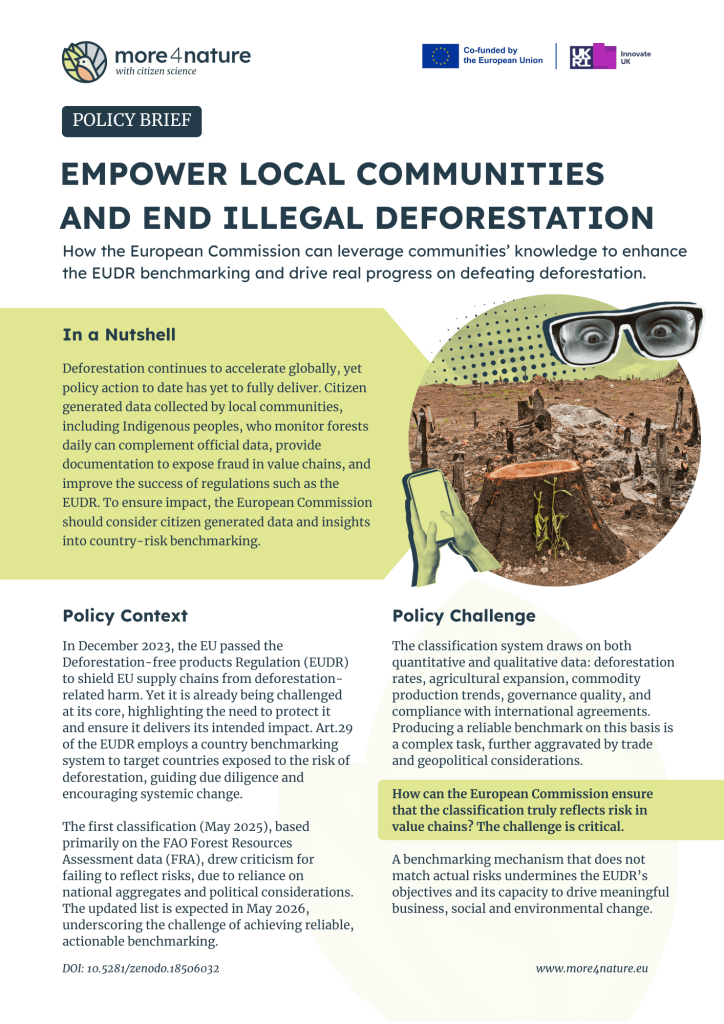
Empower local communities and end illegal deforestation
Deforestation continues to accelerate globally, yet policy action to date has yet to fully deliver. Citizen generated data collected by local communities, including Indigenous peoples, who monitor forests daily can complement official data, provide documentation to expose fraud in value chains, and improve the success of regulations such as the EUDR.
To ensure impact, this policy brief asks that the European Commission should consider including citizen generated data and insights into country-risk benchmarking.