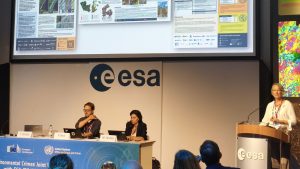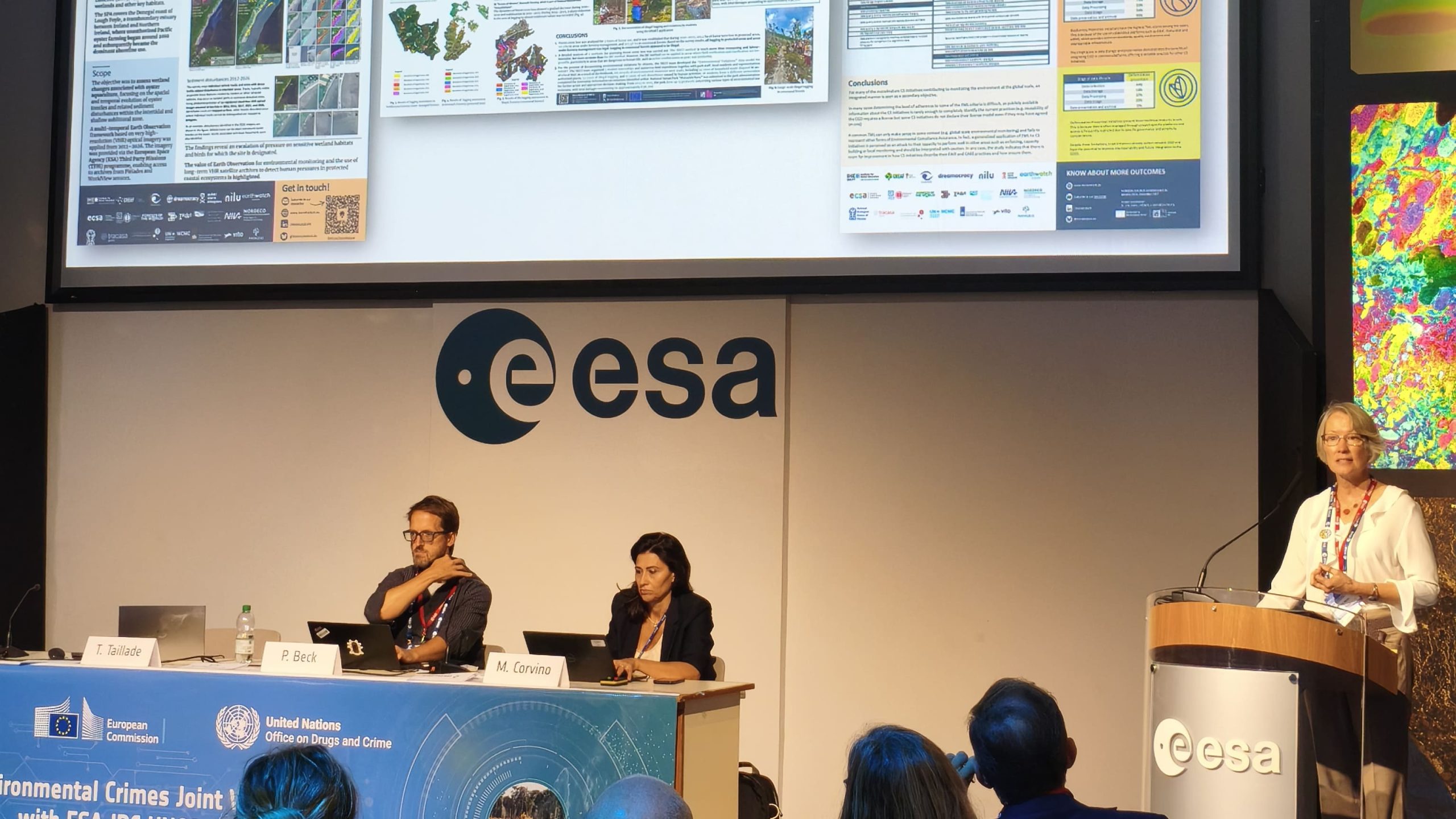
Once again this year, the European Space Agency (ESA), the Joint Research Centre (JRC) of the European Commission and the United Nations Office on Drugs and Crime (UNODC) joined forces to host the Environmental Crimes 2026 Workshop in Frascati, Italy. This forum is a key meeting point for the European and international community working to increase the uptake of Earth Observation technology in environmental compliance assurance.
Following its participation in the 2024 edition, more4nature featured in the 2026 workshop programme, this time with four contributions. Two of them highlighted cross-cutting aspects of our projects, namely the social and technical knowledge produced to support the integration of citizen science data and action into collaborative environmental compliance assurance. The other two presented outstanding real-world examples drawn from our cases tackling oyster trestles in Lough Foyle (Ireland) and illegal logging in National Nature Park “Hutsulshchyna” (Ukraine).
A methodology that unlocks new collaboration possibilities
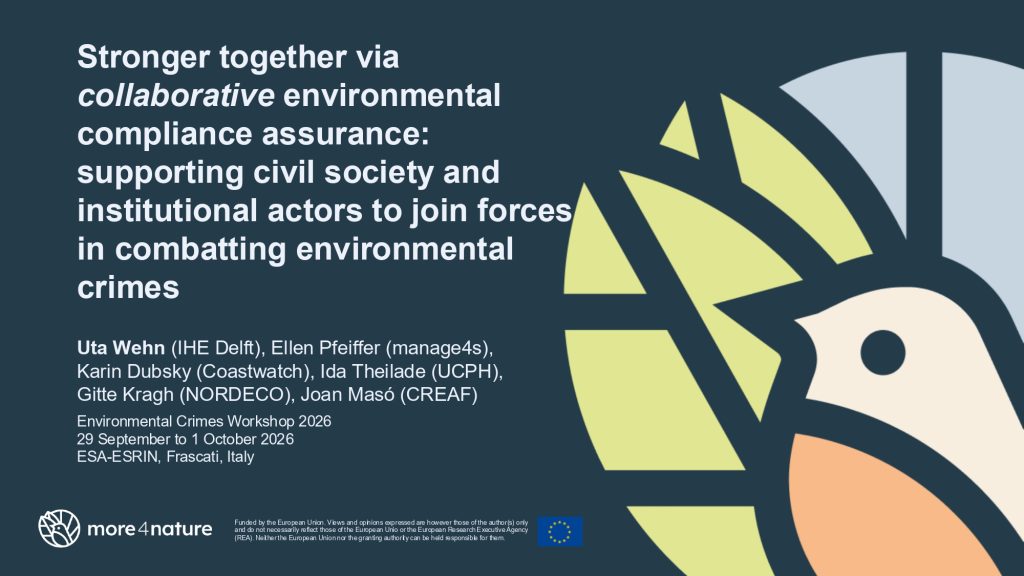
| Session 3 – ID: 144 / 2.1: 4 Stronger together via collaborative environmental compliance assurance: supporting civil society and institutional actors to join forces in combatting environmental crimes Uta Wehn, Ellen Pfeiffer, Karin Dubsky, Ida Theilade, Gitte Kragh, Joan Maso |
While international regimes, legislation and respective local policies to manage environmental resources are mostly in place; water and air pollution, biodiversity loss and deforestation keep up in many parts of Europe and globally. Some of the contributing factors are gaps in the implementation of these policies and insufficient compliance by duty holders.
A presentation by Uta Wehn (IHE Delft) showcased how citizen science can help improve effectiveness of ECA systems by joining forces with authorities, whenever possible, and by holding them accountable in combatting environmental crimes, if needed. For that, the methodology developed by more4nature is creating space for visioning and socio-technical experimenting with new roles and interactions among citizens and authorities that create possibilities for collaboration previously unimagined.
Assessing technical maturity levels of citizen-generated data
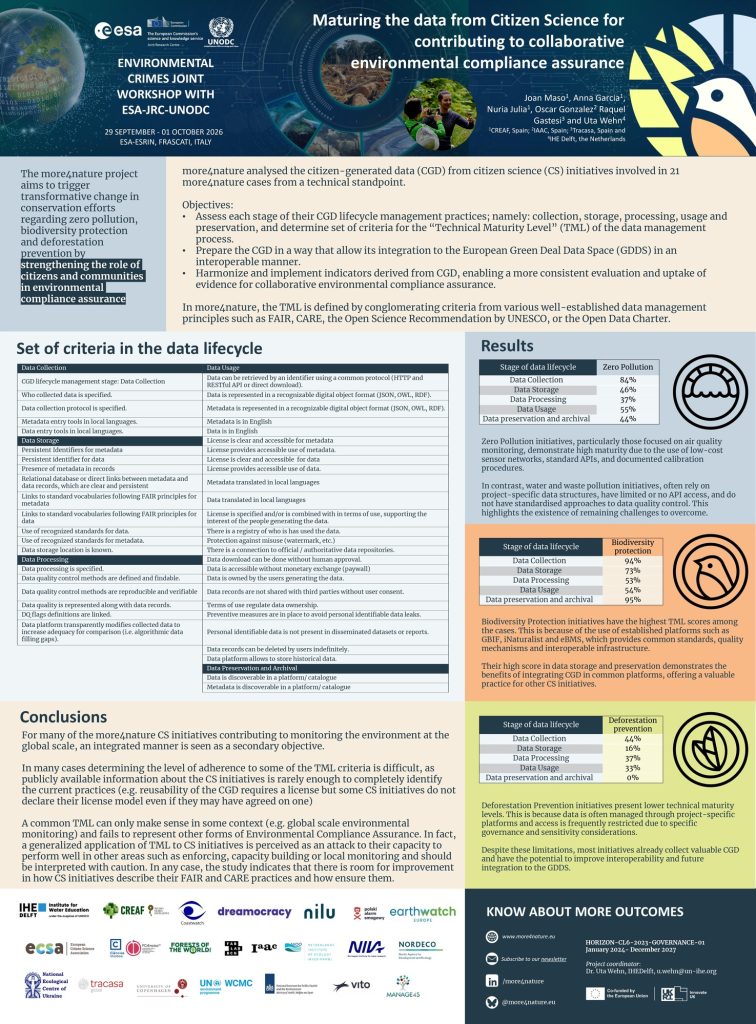
| Poster – ID: 145 / W.PS 1: 23 Maturing Citizen Science data for collaborative environmental compliance assurance Joan Masó, Anna Garcia i Rovira, Núria Julià, Óscar González, Raquel Gastesi, Uta Wehn |
The technical aspects of citizen science data often do not receive the attention they deserve, even though they are key factors undermining authorities’ confidence in the accuracy of such data. In more4nature, the technical side of our cases is monitored on an ongoing basis.
This poster presented the Technical Maturity Level (TML) analysis of 21 more4nature cases. The analysis assessed how citizen-generated data are managed at each stage of their data lifecycle, from collection to storage, processing, use and preservation. The TML is calculated using criteria that bring together several well-established data management principles, such as FAIR, CARE, the UNESCO Recommendation on Open Science and the Open Data Charter.
The analysis found that maturity varies across domains. Cases focused on biodiversity protection achieved the highest TML scores, followed by the air quality community, then the water and waste pollution communities, and finally the deforestation community. The analysis also acknowledges that assessing compliance with some TML criteria is often difficult for citizen science initiatives. Moreover, while high TML score does not necessarily represent all forms of environmental compliance assurance, but it provides valuable knowledge into to data lifecycle management and can support the use of citizen-generated data by authorities and stakeholders.
Evidence of non-compliance: illegal oyster farming in Lough Foyle
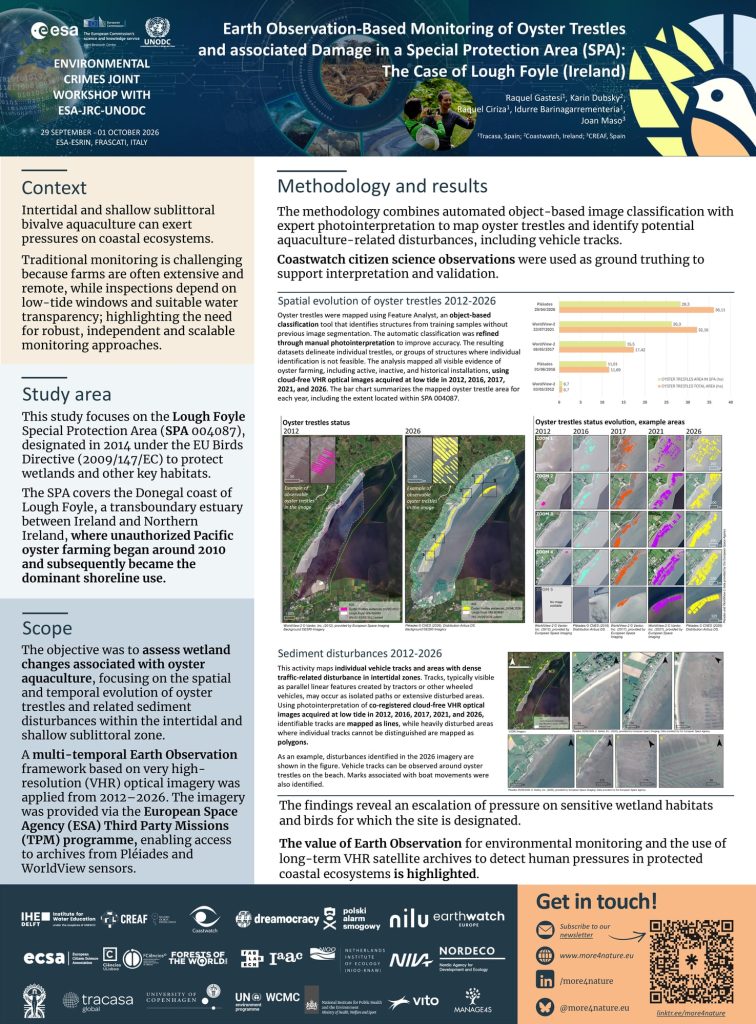
| Poster – ID: 115 / W.PS 1: 7 Earth Observation-Based Monitoring of Oyster Trestles and associated Damage in a Special Protection Area (SPA): The Case of Lough Foyle (Ireland) Raquel Gastesi, Karin Dubsky, Raquel Ciriza, Idurre Barinagarrementeria, Joan Maso |
Since 2010, illegal Pacific oyster farming has increasingly become the predominant land-use along the coast of Lough Foyle, a cross-border estuary between Ireland and Northern Ireland. This is placing significant pressure on the coastal ecosystems of a shore that was designated a Special Protection Area in 2014 under the EU Birds Directive.
Local communities are concerned, particularly as traditional monitoring is difficult in this case due to the location of the farms and the limited time available, which depends on low tides and water clarity. However, an opportunity has emerged: analysing changes in aquaculture structures and sediment disturbances using satellite imagery and ground-truthing this information through citizen science observations.
This poster showcased the initial findings from this more4nature case at the Environmental Crimes 2026 Workshop. These revealed increased pressure on sensitive wetland habitats, including the birds for whose protection this area was designated. This highlights the value both of citizen science and of Earth observation for environmental monitoring and the use of long-term, very high-resolution satellite archives to detect anthropogenic pressures on protected coastal ecosystems.
A severe crisis: illegal deforestation in Ukraine
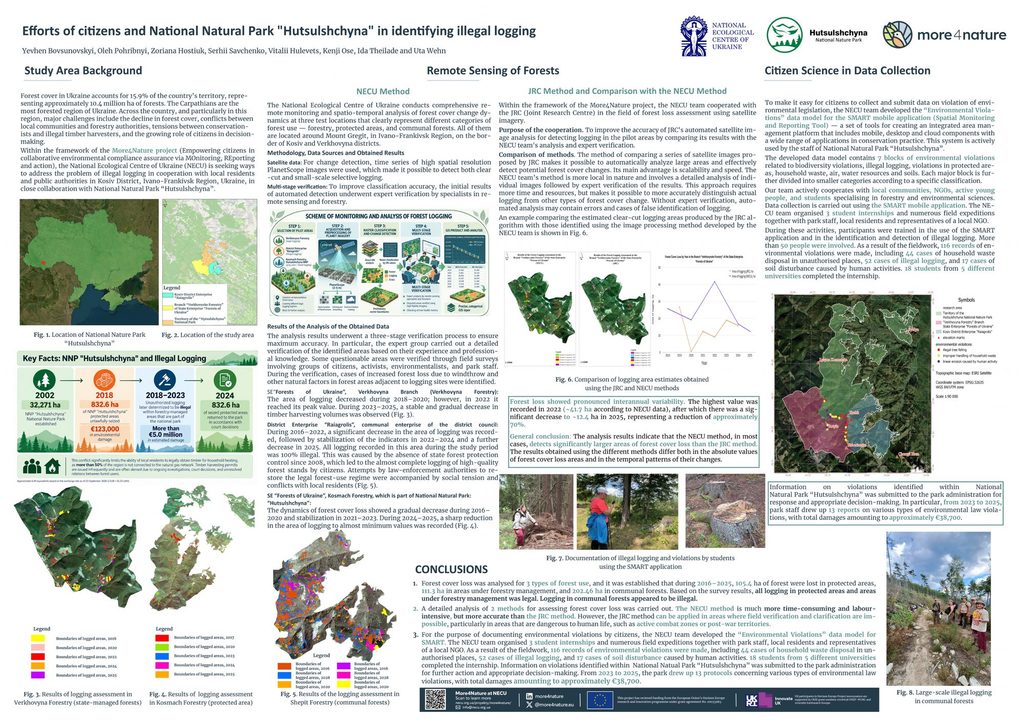
| Poster – ID: 123 / W.PS 1: 4 Efforts of citizens and National Nature Park “Hutsulshchyna” in identifying illegal logging Yevhen Bovsunovskyi, Oleh Pohribnyi, Zoriana Hostiuk, Sergyi Savchenko, Vitalyi Gulevets, Kenji OSE, Ida Theilade, Uta Wehn |
Illegal logging is a pressing challenge in Ukraine, a country where forest cover 15.9% of its territory. In the Carpathians, the more forested region, tensions between local communities, conservationists, illegal harvesters and authorities are hindering proper resource management.
A more4nature case, facilitated by NECU, seeks to flip the script by enhancing cooperation between residents and public authorities in Kosiv Distric and Ivano-Frankivsk Region in close collaboration with National Natural Park “Hutsulshchyna”.
Remote sensing and spatio-temporal analysis of changes in forest cover conducted by NECU have already revealed that illegal logging is particularly affecting communal forests. In this context, citizens have already contributed to on-the-ground verification and alerting, with 116 records on environmental violations registered via a recently developed mobile app called SMART. This tool is already being used by staff of the National Nature Park.