In 2022, 195 countries and the EU agreed on the Kunming-Montreal Global Biodiversity Framework, paving the way towards taking urgent action to halt and reverse biodiversity loss and set nature on the path to recovery. In February 2026, these countries will submit a national report to the Convention on Biological Diversity, summarizing their progress towards achieving the 4 goals for 2050 and the 23 targets for 2030 defined by the Framework. For the first time, civil society organizations and lower levels of government, like municipalities, have the opportunity to also submit a Non-State Actor report and contribute to get inputs into the global assessment of the progress, the Global Review Report. The deadline is 28 February 2026.
Finn Danielsen and Gitte Kragh, researchers from the more4nature partner NORDECO (Nordic Foundation for Development and Ecology) are offering up-to-date information about the process to any civil society organization engaged in citizen science or community-based monitoring and keen on contributing with a report. In addition, the researchers are gathering as many experiences as possible to broadly share the community’s key takeaways and foster collective learning from this unique process.
If you submit a Non-State Actor report and would like to share your experiences with this new process, please write to fd@nordeco.dk and gitte@citizenscience.dk.
Find below some relevant information on how to contribute with a Non-State Actor report to the Convention on Biological Diversity before 28 February 2026. This compilation has been prepared after contacting people who are familiar with the process as part of our activities in the EU-funded more4nature project.
Why should I contribute?
Submitting a Non-State Actor report ensures that what you do, or are doing, is reflected in the Global Review Report. It aligns field evidence and practice-based examples of conservation efforts by citizen science and community-based monitoring practitioners with the government’s targets and their headline and binary indicators. It supports inclusive reporting reflecting diverse voices. It encourages open discussion of challenges and lessons learned. It strengthens long-term engagement with governments.
Note that all these good reasons for contributing are very well aligned with the aims of most environmental citizen science programmes.
Format of report and where to submit it
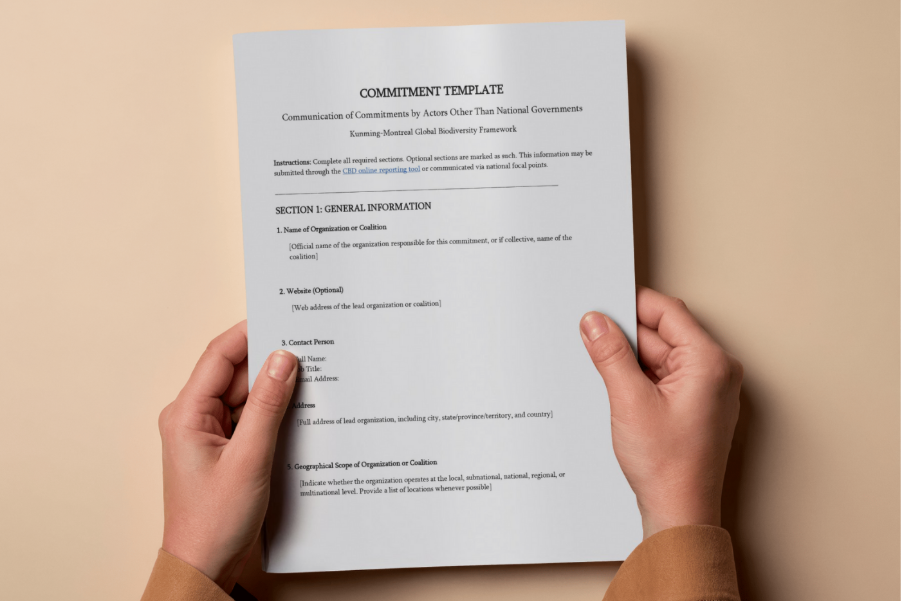
The format for Civil Society input to the Global Biodiversity Framework is provided below and can be downloaded as a Word document.
The report should be inserted in the Online Reporting Tool of the Convention on Biological Diversity. An account is needed and can be created also following this link:
Important: The account must be created on the platform as early as possible to ensure it is approved by the Online Reporting Tool administrators well before the deadline.
What is the report supposed to contain?
Civil society organisations should produce short, verifiable, evidence-based content that is aligned with the national and/or global targets and are easy to be picked and used in the Global Review Report. This could be case studies, stories of change, data, but also challenges, opportunities, gaps, and innovative solutions.
What is the deadline? What is the broader time frame?
- 28 February 2026: deadline for submission of reports to Convention on Biological Diversity.
- March – June 2026: The Convention on Biological Diversity Secretariat analyses the national reports and Non-State Actor reports that were submitted and prepares the Global Review Report on collective progress.
- October 2026: At Convention on Biological Diversity COP17 in Armenia, Parties will review the Global Report and adopt decisions which provide details on the challenges to progress with the implementation of the KMGBF and how to address them. Parties then need to take action on challenges, gaps and opportunities that have been identified.
What is the commitment?
Voluntary, forward-looking pledge, registered in a standard format, where a civil society organisation explains what they will or continue to do, by when, with what scale/indicator, and how it contributes to specific KMGBF and/or national targets.
What are the risks?
In case an insufficient number of countries and/or content is submitted, this would risk providing an inadequate picture of global progress. This would be a missed opportunity. Non-State Actor reporting could to some degree alleviate this.
How to boost national advocacy impact?
For maximum impact, and given the short timeframe, we recommend working jointly with other civil society organisations through collaborations. If possible, facilitate dialogues and direct engagement with government officials and representatives of local communities.
How can I connect national-to-global advocacy?
Even if your content doesn’t make it to the Global Review Report, it is worth using the Non-State Actor report route to mobilise civil society and ensure ongoing engagement with national governments.